Textual Analysis of an Opening Sequence: 'Blue Velvet'
In the opening couple of minutes of Blue Velvet, David Lynch creates an image of a utopian suburban America. This can be seen in the first shot, which shows a white picket fence with red roses against a blue sky. This portrays a picturesque setting and the colours of red, white and blue connote the American flag. Alongside the relaxing music, it makes the viewer feel temporarily at ease with the ‘perfect’ scene.

There
is then a fading transition, to give a slow pace and coherent feel, between the
next shots, which again represent the ideal suburban America in the fifties.
For example, the old fashioned fire engine with the waving fireman and the dog
give the feeling of safety and security. Also, the red truck, blue shirt and
white dog again show the colours of the American flag, which continues the
patriotic sense of the scene. Through this, Lynch is representing the setting
as a beautiful place where nothing bad happens. However, as the scene
progresses the viewer learns that this is not the case.

The first example of everything not being as perfect as it may seem is the shot of the television, which shows a gun. This suggests a type of crime drama and gives the sense that the utopia is actually underpinned by darkness. However, the music remains the same – cheerful and calming – which is contrapuntal with the shot of a gun on the screen.

The feeling of unease truly sets in when the scene moves onto the man in his garden, immediately following the shot of the gun. The close up shots of the hose spraying water and where it is caught suggest that something has gone wrong. Then the man collapses suddenly, without any apparent reason. This is a hook to the viewer and is emphasised by a close up of the water spraying in the air.


The first example of everything not being as perfect as it may seem is the shot of the television, which shows a gun. This suggests a type of crime drama and gives the sense that the utopia is actually underpinned by darkness. However, the music remains the same – cheerful and calming – which is contrapuntal with the shot of a gun on the screen.

The feeling of unease truly sets in when the scene moves onto the man in his garden, immediately following the shot of the gun. The close up shots of the hose spraying water and where it is caught suggest that something has gone wrong. Then the man collapses suddenly, without any apparent reason. This is a hook to the viewer and is emphasised by a close up of the water spraying in the air.


Editing is
used to show the dog biting at the water in slow motion; this represents how
animalistic and vicious it looks, despite the fact its owner is on the ground.
Through this shot, Lynch is stating how animals are nothing more than wild
creatures and the fact it doesn’t truly matter to them what state their owner
is in. The idea is not pleasant and is a contrast to the obedient dog on the fire
engine shown earlier. It could also be possible that the fact the man collapses
into the space where he’s trying to grow grass represents the futility of life
and his plans for the future being crushed suddenly.
The final part of the scene is the most creepy and the
best representation of the feeling of the rest of the film. The music, which
has been constant throughout the rest of the scene, begins to fade out and is
replaced by the scratchy sound of beetles. This is in time with the camera
zooming in to an extreme close up of the grass, which makes it look
jungle-like. When the change in sound and zooming in are paired together, it
gives the impression that there is danger under the picturesque image
constructed at the start of the scene.


Textual Analysis of a Horror Film Opening: 'Scream'
'Scream' is a horror film; within the opening five minutes it represents the stereotypical young female victim and a male antagonist that are so common in this genre.
As suggested by the film's title, sound plays a large part in the opening sequence. The opening titles feature the sound of a phone ringing and a scream, which suggests their prominence later in the plot. In the extract, there is a focus on the diegetic sound of the phone ringing, the doorbell and the victim's screaming. This adds to the sinister feeling. Non-diegetic sound is also used in the form of backing music and sound effects, which emphasise the scarier parts and emphasises a change in tone, suggesting the events are about to get worse.
The sudden change in tone is also represented through the camera shots. Throughout the extract, the camera follows the character around her house, which hints at the fact she's being watched, creating tension.

However, when the antagonist on the phone says 'no you listen' and 'I want to know who I'm looking at', the camera zooms in suddenly, showing the character's frightened expression. This is to emphasise fear in the viewer, by representing it in the victim.

As with sound, the camera shots represent the important aspects of the scene with close ups, such as on the popcorn and the phone. This adds to the tension of the scene, as the viewer wonders what the significance of these props is. Another important prop is the kitchen knife, which the victim is shown to be moving nonchalantly, foreshadowing the upcoming violence later in the scene.


Textual Analysis of a Thriller Opening: 'Se7en'
'Se7en' (1995) is a neo-noir psychological thriller directed by American director David Fincher, starring Morgan Freeman and Brad Pitt.
The opening/title sequence establishes the tone of the film; in the case of 'Se7en' this is creepy and harrowing.
This tone is created through the camera angles, movement and position. Primarily, by the high frequency of extreme close ups, which mean the audience never sees the character's face, to create a sense of mystery and fear of the unknown. The camera movement are erratic to create tension.


The editing of the opening titles are also important in setting the frightening tone. It is non-linear, with several sudden jump cuts and a lot of movement. This sets a fast pace for the film. There is also lots of flickering text and overlays, which disorientate the viewer. The transitions are inconsistent: some are straight cuts and others cross fade. The editing gives an idea of the disturbed character being portrayed.


The sound of the opening scene, featuring Morgan Freeman in his apartment, is settled. There is mostly diegetic 'city' sounds, such as cars. Most significant is the metronome, which is steady, though it suggests the calm before the storm. This sound is a contrast to that of the title sequence, which is entirely non-diegetic. At the start of the titles, there is only the slow, more monotonous music alongside the scratchy, high pitched sound effects, which are very eerie. About two thirds into the sequence the music begins to build up, which makes it more tense and disturbing.
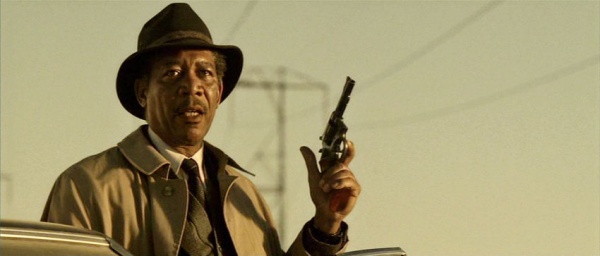
In the opening sequence, the Mise en Scene suggests a stereotypical detective, with props and costume usually associated with this character. However, in 'Se7en' it is more unconventional as it features an older, black man as the detective instead of a younger white man (which we see in Brad Pitt's character). Morgan Freeman's character is represented as highly organised, to the point of suggesting OCD, as everything on his desk is shown as laid out and arranged precisely. The chess board in the apartment connotes a game between the detective and the serial killer.
The title sequence is unclear as to the setting, although the low key lighting suggests it could be in a basement or a similar place. The darkness connotes danger and the dark theme of the film. There is little colour in the sequence, other than flashes of red that also connotes danger, as well as showing the photos as being developed.


The character in the titles, who is presumed to be the serial killer, is represented as intelligent as well as disturbed, such as in the extreme close up shot of them shaving their fingerprints off. Also, they are shown to be crossing out certain words from texts, such as 'intercourse' and 'transsexual'. This suggests extremist views, particularly Christian.


Textual Analysis of a Romantic Comedy Opening: 'Easy A'
I have already analysed multiple film openings to understand how to create one of my own. However, in order to successfully create an opening sequence of a romantic comedy, it is essential to recognise and understand the key conventions of this genre specifically. Therefore I have chosen to analyse the opening of 'Easy A', a 2010 American teen rom-com directed by Will Gluck and starring Emma Stone.
Firstly, the opening titles are incorporated into the scene rather than being in a separate title sequence, as is common in this genre. The font is simple, white and bold, which suggests the film will be easy to watch and light-hearted.

There are a series of establishing shots to indicate the location, which ends with a high school setting. The mise-en-scene includes several extras in typical teenagers' costume, which shows how busy the school is. The camera then pans through the set; this gives the impression to the viewer that they are part of the scene. The lighting is bright and there are bright colours, again this gives an idea of the mood of the film, which is light-hearted and funny.


There are two major components of the sound in the opening scene. Firstly, the background music, which an upbeat pop song that sets the mood for the film. The music then fades out to a quieter volume and is mainly replaced by a voice over by the protagonist. The voice over is a key convention of the romantic comedy genre.
The scene then cuts to the protagonist talking to a webcam. This is a contrast to the main narration of the film and indicates that the film is a story being told in flashbacks by the character in front of the webcam.
This editing with cuts between several scenes continues throughout the opening sequence, all tied together by the narration in the voice over.


In films that are aimed at teenagers and set in a school, such as 'Easy A' and our film we are planning, age is a key social group that is represented. This tends to be shown through the contrast between teenagers and teachers or parents. In the opening scene, age is represented by the middle aged teacher. A low angle shot is used to show him, which connotes his power and authority.